
Arachnophilia
Or, Affinity for Spiders by J. Aaron Courts

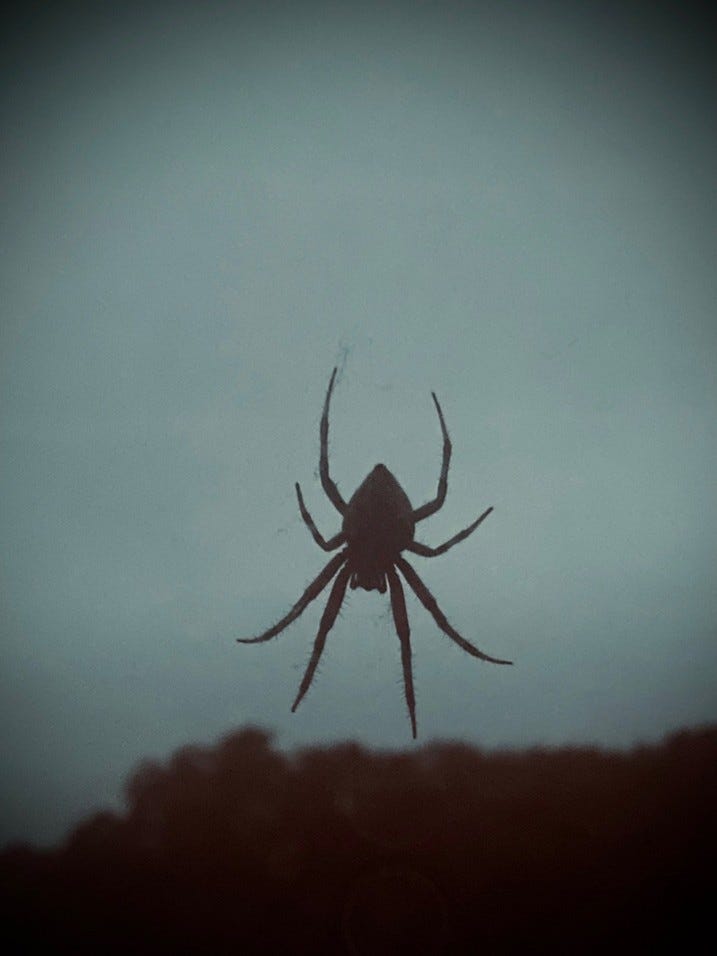
There’s a spider in my daughter’s room I named Darling, a Neoscona crucifera, the spotted orbweaver, and my daughter doesn’t know I’m feeding her. No one does. You can’t tell from wherever it is that you’re reading this, from whatever device or sheet of paper you’re holding, but right now, at this exact moment, I’m leaning in. Looking left and right for eavesdroppers, which is silly because I’m the only one here. Still, I feel like this is a secret I want kept between the two of us, and so I’m going to whisper it to you.
Here, get close. Listen.
No one knows I feed spiders but you.
What’s the opposite of arachnophobia? Arachnomania? No, I don’t think that’s a word. I need to brush up on my etymology. Arachnogratias. An appreciation for the eight-legged predators. That’s better. Still, I can’t keep from asking myself, “Is that the sum of things?” I’m not so sure.
Is it love or a strong affinity? Arachnophilia, perhaps?
Yes, now that strikes a chord.
I don’t want to be misleading though. I mean, don’t get me wrong, I’ve killed my share of spiders. Just mostly by accident. Still, the truth is, I have no aversion to killing, necessarily, whether the creature is large or small. I’m a hunter and meat eater. I’ve killed and eaten every sort of animal you can think of, but the first I can remember was a Brewer’s Blackbird. It was one of many millions migrating through Southeast Texas in the late fall of ‘87 or maybe ’88.
The shot I made wasn’t the easiest. A real Carlos Hathcock moment before I even knew who that was, but I’d been practicing with my spring-loaded Daisy for days. I sat against the trunk of the largest tree in my grandmother’s yard, an enormous sycamore, and I piled its fallen leaves around me, which was difficult because of the shifting wind. I’d built the swirlingest bird-blind in all of Texas that day and waited for what seemed like forever in the growing chill, trying to contain my shiver and not rustle the crunchy leaves and scare the birds from landing.
I waited and waited, and my patience paid off. Hundreds and hundreds of black birds peeled themselves from the rest flying overhead and settled in the yard. My Daisy thunked, and I followed the copperhead BB with my eyes as it arced. It struck the hapless bird where its head connected to its neck and the thing flopped and fluttered and all the other birds took flight.
I marveled at what I had done. I held the thing up by its wings, stretched to their peak between my fingertips, and thought about the painting of Jesus Christ hanging on the cross, that I saw at church every Sunday morning and every Sunday night and most of my Wednesday evenings, and I rested the dead bird in my palm instead.
I can’t remember where she was that day, my grandmother, I mean, but I do remember trying to figure out the best way to show her the bird. I recall debating whether or not I should hide it between my hands then reveal it like a flower or maybe ask her to close her eyes and stick out her hands and surprise her like it was a gift. In the end, I thought it would be better to sprawl it out on the brick eve under the large double window that looked in on her kitchen table and have her close her eyes and walk her to it.
And just like for the birds, I waited and waited, again, almost as long as I had for them to land, and when she finally pulled into the driveway I ran to her car door. I opened it before she even turned off the Buick’s engine and all but dragged her to the front porch.
“Come on, come on,” I said and pulled. “I gotta show you something!” She laughed and allowed me to guide her. I slowed when we got to the porch because my grandfather had placed two pea-gravel Texas-shaped steppingstones directly in front of the porch—gifts from him to her for her birthday or Christmas or maybe Texas’ Independence Day—and I didn’t want her to trip and fall. “Okay,” I said, “open your eyes.”
I might have put a hand over my mouth; I was so excited. When I showed her my kill, she looked down at me and smiled. I could have floated away if she weren’t still holding one of my hands. She called me her big hunter and said you must be proud. And I was. Proud, despite seeing a little black, feathered Jesus. That is until she asked what I was going to do with it. She said it softly, kindly even, but her words landed on me like a felled tree lands on the ground, and I was crushed underneath the weight of what she was asking.
I hadn’t considered what I would do with the life I’d taken simply because I could. I hadn’t considered anything other than the BB’s drop and how high to aim above the bird’s head. I just wanted to shoot a thing. To make a clean shot. To take a life. To kill something.
My grandmother recognized this.
She had me pluck the dead bird, and gut it, and rinse it in the sink, and roast it in the oven, unseasoned, then sit at the table and eat it—all of it—until I used my nails and teeth to scrape the paper-thin strips of rib meat from between its soft-caged bones and eat all of that too, sobbing.
I asked for milk, but she said no and pulled a mason jar from the cabinet. I could have water.
I went to the sink and took the chip-rimmed jar from her hand but there was a dead house spider curled up at the bottom. It must have crawled inside of the jar in the cabinet and found itself trapped.
I cried harder, but not because the spider had starved to death. That’s a terrible way to go, of course. Alone, and in the dark, starving or thirsting to death, just waiting from someone to drink your corpse. I definitely had bad dreams about all of that for a while. But no, I cried harder because when I showed her the dead spider in the jar, she simply blew it out, gave it a quick rinse, then filled it from the tap anyway. My glass of water smelled like Mayhaw jelly and tasted like spider.
I know it was all in my head, but for a long, long, long time, I couldn’t drink out of a mason jar. Brewer’s Blackbird remains the worst meal I’ve ever had, and I’m pretty sure I ate rat meat in a red-dirt village in Tanzania on my last deployment, which, I might add, for the record, tasted just fine.
Now my mother would say I was a picky eater, but I’d say, if that was true, then I’ve grown out of it. I’ve eaten all sorts of things. All sorts of crustaceans, and roe, and fish. A sushi chef in Okinawa once served me chicken sashimi—that is to say raw chicken—both white and dark meat. I’ve had all sorts of warm-blooded mammals too. Shoot. I ate whale in a small joint a few hours north of Tokyo.
I’ve also eaten camel, and crickets, and frog legs. I have eaten alligator on a stick, turtle in soup, and snake in prairie stew. And, of course, that mystery meat in the Horn of Africa. I’ve eaten horse. And I’m from Texas—it’s damned near a hangin’ offense ‘round here. And once, I even ate roadkill with my stepfather and stepbrother on a hunting trip into the Davy Crockett National Forrest in Kennard, Texas. That was the tastiest beer-stewed rabbit and potatoes I’ve ever had, and we cooked and ate that rabbit in a foil-lined hole in the ground. Unlike my little black bird, I can cook a rabbit so delicious you can taste the love in it. I mean it. The love. Which makes perfect sense. We name them, our rabbits, and my kids play with them, and then, when it’s time to harvest their meat, I kill them. Humanely of course, and I’m happy to report, not a single one of our rabbits has ever seen another killed, so I’m certain that adds to their flavor. And while I make an effort to kill only what I plan on eating—thanks to my grandmother and some jelly flavored spider-water—there are other reasons.
The most obvious, to protect oneself, sure, but I’m a trapper too. Predators and varmints, mostly, but some other fur-bearing creatures. I skin them, scrape their flesh of fat and muscle and what connective tissue keeps the skin from sliding off their bodies, and then tan them.
And I’m committed. I’ve been exposed to the rabies virus in the process of separating some of that connective tissue from the single most impressive racoon I’ve had occasion to interact with. We changed each other, that coon and I, and I’m not being dramatic when I say so. It was a profound experience, and that was before we thought I might need to be tied to a tree and shot.
In truth, I can’t be certain there was an actual exposure. I’d already disposed of his carcass, so the remains couldn’t’ve been tested for the fatal virus even if I wanted it done. And I can’t remember if it was two days or maybe three—let’s say several days—after “exposure,” before I sat and really thought about the implications of exchanging bodily fluids with a coon. Before I considered how he behaved so strangely. But it had been several days, and that’s exactly what had happened, and he had been acting very peculiar, so I called the hospital to see what they thought.
I informed the on-call nurse that a little brain matter and saliva from a squirrelly coon got mixed with some of my blood in an open machete wound from the week prior. The superglue had worked and the middle knuckle on my left index finger was good and scabbed over, but the coon’s warm blood and, more importantly, brains and saliva, those latter being the two ways you contract rabies, softened the scab, and as I curled his hide in my hands and began to peel it from his body, I felt my knuckle burn. The wound opened and his skinning became a more intimate affair, if such a thing is possible.
The nurse asked how many hours it had been since my exposure.
“Oh, I don’t know exactly.” I laughed. It was a nervous laugh.
“Well,” she said, “Was it before or after chow?” She meant that day. Lunch. “I just need to know about how many hours it’s been.”
I hesitated and winced. “Probably seventy-two then.”
She shit a gold brick, and let me tell you, that nurse cussed me out as good as any Gunny ever has.
You see, she worked at the Naval Hospital aboard Camp Lejeune, so they’re used to dealing with dumbasses, and I’m a Marine, so she didn’t have any time for mine. Especially since I was there the day before, after punching a drill bit through the web of skin that connects my left thumb and the same left index finger.
But the risk of exposure was significant enough to come in, she said, so after she let me have it, I drove to the hospital and checked myself in, again. Tetanus one day, rabies the next.
The doctor had two nurses—thank God she wasn’t one of them—bend me over a gurney and take turns stabbing me in my dumb ass, with a dozen needles or so, and I wobbled out of the place with two cheeks full of the vaccine and a finger full of so much globulin the clear liquid was leaking out of the pores around my finger nail. Not sure if you know this, but there are tiny pores on the top of your finger, just behind the nail and all around the cuticle, and if you have the finger placed in a tourniquet until it turns purple and pumped full of the globulin they give you as part of the rabies vaccine, that you will most certainly discover just how many tiny, otherwise invisible pores your finger has. I’ll give you a hint. It’s a lot. I also left the Naval Hospital with a pending call from the Center for Disease Control in North Carolina. The whole affair made the installation’s blotter, and I got to explain myself to the Chief of Staff the following day.
So, you could put it all on black and bet your last dollar that I have no problem killing things.
But I don’t like killing spiders.
Since we’ve moved back to The Great State of Texas, and South Texas at that, I’ve made friends with several spiders. Mostly the Aphonopelma anax, more commonly known as a Texas tan tarantula. I saved Caeneus last year from the bottom of our pool’s skimmer basket. That’s what I named the teenaged tarantula, Caeneus. I swept the fine Texas dust from the bottom of the pool and netted all the stupid leaves from the largest scrub oak in our yard, then went to dump the baskets. That’s when I saw her—or him—sucked down and pinned underwater. I turned the basket and tapped the bottom with my palm to dump the oak leaves and other debris and spider, and to my surprise Caneus didn’t fall out. She—or he—wasn’t pinned to the bottom at all but clinging to it, breathing the tiny air bubble stuck in its little hairs near its mouth or nose or whatever spiders breathe through. I have no clue how long they can do that for or for how long this spider was submerged. I massaged its body then laid the exhausted thing on a rock to dry and sat there with it until it had the strength to crawl away so no opportunistic birds could make a meal of it.
Prior to that, there was a Carolina wolf spider. Those are Hogna carolinensis, and I called her Lady. We grew to be close at the same house where I became a CDC statistic. There was a small hole in the old wooden siding around our door frame on the front porch, and I almost entombed her behind a squirt of expanding foam. But there she was, fat-sacked, dragging a pouch full of babies around by her spinnerets, and I couldn’t do it. I was washing dishes later that day, or maybe the next, and a housefly was buzzing between the screen and glass of a small window about the sink that overlooked our backyard. It had found its way in through one of three .22 caliber holes in the screen, the evidence of several shots I’d taken from inside the house at one time or another, but it couldn’t find its way back out.
I opened the window and gently pinched the black fly between two soapy fingers, careful not to squish it, then carried it to Lady. I wasn’t sure if a wolf spider’s burrow was sticky, so I ripped the fly’s wings off before placing it on the thick web, and she scurried out and snagged just as I let the helpless bug go. And that became our routine. I fed that momma spider flies and mosquitoes and moths for more than two weeks. Fine, easy dining for an arachnid.
I broke a Marine’s leg once and that snap—that pop—was terrible but nothing compared to stepping out on the front porch one evening and hearing a tiny pop under my barefoot, then feeling her babies, hundreds and hundreds of them, crawling across my foot and up my leg. You might think it was because I was wearing shorts, and they were crawling up them. They most certainly were, crawling up my shorts, that is, but you’d be wrong. I just didn’t want to hurt any of the itty bite-sized babies. I was careful in wiping them off and only hurt a few dozen. The next day, I had to force myself not to bury Lady, who was just a spider, after all. I’m still not sure why I didn’t though. Because I thought it would be too weird? Weirder than looking for bugs and feeding them to her?
Ah, she was just a spider. But also, one I’d befriended, fed, and so carelessly killed.
But the earliest spider I can remember befriending came into my life when I was first stationed at Camp Lejeune. Coastal Carolina is about as similar to Southeast Texas as one can find in the Corps. Pine trees and eddies. Live oaks and sloughs. Hell, we’ve both been strongholds for pirates. It’s a place that continues ooze raw wilderness even if the thwacking blades of helicopters and photo-rattling boom of howitzers can be heard above it all. I should have felt at home there, but I was alone and didn’t. That is, until I met the spider.
It happened one day while I was still a non-rate. That meant, a troop that “rates” nothing except what’s given and, of course, a hard time. We don’t use that term anymore, we call them junior enlisted Marines, but we did then, and it was true. I worked at the Ammunition Supply Point—the ammo dump or simply the ASP—there at Camp Lejeune. As a young Leatherneck, I lived in the barracks and everything I owned could fit in my seabag and wall locker, and everything in the wall locker was issued gear so, technically speaking, not owned by me at all.
I lived in a tiny room then with two other young Devil Dogs, one of which was the barracks thief and the other a complete jackass. Those were days ripe with hazing. The sort of stuff 20/20 makes specials about to scare folks away from the Corps but ends up recruiting the exact sort we’re looking for.
My mother called me into her room one evening while I was still in high school because one of those news shows did just that—an exposé on hazing in the Corps. It was a national scandal, and the Marines officially banned a lot of it. But that only made those of us too young to have already enlisted, cats like me, intrigued by the rituals and dying to get as much of them as possible, all the more eager to join and get what we could before it went away.
The hazing didn’t stop, of course. Marines just got more creative, and we, those of us late to the party, got exactly what we asked for, and then some. We weren’t hazed by thieves or jackass roommates. One only tolerates that sort of thing by a person you respect or by a person you fear, I suppose. No, it was the Noncommissioned Officers, the NCOs, equally feared and respected, that held on to the old ways. And the Staff Noncommissioned Officers, the SNCOs—the good ones—that looked the other way. And there were a lot of rituals that came with working in an ammo dump, and plenty of folks who were eager to keep them alive and well.
This ASP was full of turtle shells. Not the hard-domed belly crawling creatures I still stop traffic for and carry across the road, but large grass covered mounds of earth with reinforced concrete storage magazines underneath. And inside of them, ammunition and explosives. Rockets, mortars, demolitions, pyrotechnics, signals munitions, fragmentation devices, small arms, and just a little bit of non-lethal ammo (not really the Corps’ jam).
To imagine one of the small turtle shell magazines, think of a large, concrete bathroom without any toiletries. No mirrors, or paint, or tile, or shower or tub. No toilet. No sink, no towels, no floor mats, and no scale (if that’s where you keep your scale). What it does have is a thousands-pound door that takes some effort to open, and inside, steel, spark proof pallets, and, naturally, plenty of stuff that explodes.
Sunlight was the only source of illumination in the particular magazine I was working in, and the damp concrete was cool to the touch. The scent of sand filtered ground water and pressure treated ammo crates saturated the air. These magazines are echoing places, dark and protected from inclement weather, and thanks to all the earth covering, pleasantly cool in the summer and warm enough to drag one’s feet during an inventory in the winter.
There is, quite simply put, nothing extra inside of them that could catch fire or combust or invite pests. Nope. Just the shit that goes bang and boom. The magazines are rodent free because they are food free, and they are food free because the NCOs and SNCOs will kill to death the idiot that violates these procedures.
The point is, the magazines are Spartan by design and even more so in practice. They are eat-off-the-floor clean—toxic, perhaps, but clean—and I think that’s why I was so surprised to see a spider living in the little reinforced, concrete cube.
Now I have a bad habit of whistling while I work and was whistling “Dixie” that day, or maybe some old church song, but whatever I was whistling, I was whistling it good, and I found myself alone. The acoustics—the sounds bouncing off five of the six reinforced concrete surfaces—caught me by surprise and, though it’s a little embarrassing to admit, gave me chills.
I can’t recall what dragged the other Marines away or why I was there by myself. Technically, I wasn’t allowed to be in the magazine at all. A minimum of two Marines must always be present to enter any mag, but there I was, all alone, or so I thought.
I leaned against one side of the open front bulkhead and slid down until I was seated on the deck with my knees drawn and arms draped over them, just whistling away, and that’s when I saw it for the first time. I recognized her immediately. What she was, I mean. Latrodectus mactans. A Black Widow. I smiled and said, “Good morning, Ma’am.”
She, Ma’am, the spider, clearly appreciated the spot and used one of the ventilation or drainage ports to go out and look for food. It was a perfect environment, or as close to perfect as a spider can hope for, with the exception of two or three Marines visiting the place once a week to inventory ammunition, and it was all hers.
She climbed out from the pallet a few feet in front of me. Her spindly, segmented limbs carried her light as an eyelash across the smooth gray deck. She was onyx black and glistened like a ripple in the sun. And her abdomen… Is there anything more unique in the world? A teardrop of black night that shields an hourglass—a red wink at that which is most precious and fleeting—time.
Of course, I couldn’t see her hourglass, but I knew it was there.
I thought about the critter boxes we nailed together out of cheap pine boards and old screen as kids when we stayed at my grandmother’s house. All the spiders and grasshoppers and cow ants and horny toads we kept for a days, and I smiled at the memory. I greeted her once again.
“Good morning, Ma’am,” This time, she stopped. I tilted my head to one side to try and steal a peek at her hourglass, but she was modest and began scurrying away. “I’m sorry, Ma’am. That was very rude of me.” She stopped again. “Please, accept my apology.”
I was kidding of course, she was only a spider, but to my surprise, she turned. I swear she bowed, and I might have blushed. I turned to see if anyone was there. To see if the Marines had returned and were watching me flirt with a spider. I’d be tormented. I’d have to get myself thrown into the brig to escape the harassment. I felt like I did when I was seven and my first love moved away from the house next door, and I thought I’d never see anything as pretty again, and then a little blonde girl, platinum really, Hope, was the next to move in, and I couldn’t keep from staring at her. Her hair shined like a ripple too, and I wanted to kiss her before I knew what a kiss was. I couldn’t kiss a spider, but if I could… Hmm, I think I just might have tried to kiss Ma’am.
But I could sing to her. Well, not sing. I can play the sax, and a little guitar, and I can whistle a mean “Dixie,” but I can’t sing. Still, where my lips failed me with Hope, they might save me with the spider.
“Ma’am,” I said. “Would you allow me to whistle for you? I’d sing you a song,” I said, “but I can’t sing.” She didn’t move, other than to ease herself out of her bow, and I took her silent gesture to say, Why yes, Marine, you may.
And so, I did. At least once a week for months. And whenever we found ourselves alone, and I didn’t have a meal for her, she would come out to our spot and listen. I’d like to think my whistling was her favorite part, but the meals I prepared for her were special in their own way.
I’d catch crickets and small grasshoppers and other insects when I could snag one without anyone noticing me stick them in one of my breast pockets, then bring them to her as soon as I could. I’d tear off their legs or wings, or immobilize them in some other way, always careful to keep them alive, and place them on the deck a foot or so away from the steel pallet. Then I would greet her and wait. She never took long to appear, but she never hurried either, and she would walk out as carefree as sunrise, then bite them, wrap them in silk threads, and drag them back under the pallet to her web, I presume. Once, I caught a fly trapped in my barracks room, not unlike Lady’s first fly, and kept it alive for three days waiting for an opportunity to deliver a second weekly helping to my new friend, Ma’am, the black widow spider. When the opportunity didn’t come naturally, I sabotaged an inventory so I could see her.
I planned it out and laid on my stomach. The cool concrete made all the hairs on my arms stiffen and sent chills down my legs until she appeared from under the pallet. I swallowed a nervous lump.
“I’ve brought you something special, Ma’am.”
She only hesitated for a moment, then crawled toward my hand.
I pulled it back just as she reached the fly and I saw her inject her venom into its small body—a perfectly silent, intimate act—and imagined the digestive enzymes working, and the fly’s liquified insides sloshing, as she turned the dying insect over and over, not three feet from my face, before taking it away and leaving me alone to wonder.
I earned the title Marine, and that was—is—something that can never be taken away. I was a part of a brotherhood and had roommates, and buddies, and even a love interest by then, but she, the spider, was different. She was my only friend.
I went to go to the base library to check out a book on black widows and see how long she would live, but when I found the book on the shelf closest to the floor, in a small section about insects, right up against the children’s books, and pinched its spine between my fingers, I found I couldn’t pull it off the shelf. I realized I’d rather not know and left without even seeing the book’s cover. On the way out, I spotted a small butterfly fluttering over a bit of honeysuckle along the library’s fence. I caught it and brought it to Ma’am the following day, but weren’t alone, so I knelt in front of her pallet, pinched it, and tossed it under without anyone noticing. I glanced underneath the pallet before we closed the magazine and left for the day, and the butterfly wasn’t there.
But this is not a happy tale of two whistle-crossed lovers. No.
Ma’am was killed on a sweltering day at the end August 2001. It was a Wednesday. Wednesday the 29th, just after mid-day chow.
Ma’am was standing in her usual place, halfway between the forward most bulkhead and first pallet while I inventoried the ammunition. I was whistling but had my back turned to her.
“What are you doing, Courts?” The voice came from behind. I cut my note short and stood up. “You know you can’t be in here alone.” It was an NCO and I was about to get smoked. “I said, what the fuck are you doing in here?”
Marine NCOs are unlike any other breed of person on the planet. They are given more responsibility than most SNCOs in any of our sister services, and more than some of their officers too. Hell, Marine NCOs have swords. Fact. Most are giants and troops live in constant fear of being stomped by one.
My NCO was one of these giants. Hard as stone and as mean as a South Texas fire ant. I’m five foot eleven, and at five foot six and a half he towered over me. Most days I dodged his shadow for fear it would strike on its own, but both he and his shadow were stepping closer to me to snatch me up, or punch me in the face, or just get on with it and rip my head clean off. I’m sure I flinched. I don’t remember flinching, but I can’t imagine a scenario where I didn’t. Then something caught his eye and I felt him pause somewhere behind me.
“Fuckin’ spiders,” he said with genuine disdain. “I fuckin’ hate—”
The worn sole of his black combat boots stomped Ma’am flat. He might have finished his sentence, but I couldn’t hear him. All I heard was the hammer slap of his foot echo in the small turtle shell magazine.
I shoved him off of her and his hard hat toppled just in time for the left side of his head and face to strike the concrete bulkhead. He balked and reached for his ear. I knelt over Ma’am but didn’t know what to do. She was smashed, smeared really, except for her perfectly narrow legs. Three were torn from her and lay motionless, but I watched in horror as the other five tighten and curled over a cracked hourglass, and all the time we had shared was smeared with the rest of her into a spot the size of a nickel. I didn’t see him pull a bloody hand from his ear. I didn’t see him take a step in my direction. And I didn’t see his fist come down on the side of my face. The last thing I saw was what had been my friend. The last thing I saw was Ma’am.
He needed two stitches above his left ear. I needed ice and a Judge Advocate General but had taken my licks instead and that saved my rank.
I was moved into a different section the same day, which killed me because I couldn’t go back and bury her. Within a few months, I left the unit altogether.
I must have returned a hundred times over the next year or so as a using unit tech, but I never had occasion to be near the mag where I befriended Ma’am. Then, on another sweltering day, we were driving through the ASP when I saw some of their Marines working out of Ma’am’s turtle shell. It was open. It had been maybe two years, and I was a Noncommissioned Officer myself by then and told my driver to stop the truck. I climbed out of the vehicle and crossed the road. Three troops were inventorying several cans of ammunition outside, and I walked past them and entered unannounced.
The place was exactly how it’d been when I was one of the troops assigned to that section. Same smell. Same damp concrete. Same cool, echoing chamber. It was the same in every way except one. There had been a small circular spot—a stain—on the deck to the left of the open hatch, about halfway between the bulkhead and steel pallet the last time I was in the mag.
A nervous voice was behind me. “Can I help you, Corporal?”
I didn’t answer him. I stared at the deck and crouched and pressed my hand to the spot.
“Corporal, you shouldn’t be in here alone.”
Now, I’m married to a woman who shines like a ripple all the time, and I have a son and three gorgeous daughters, and a lovely home. I can honestly say, this is the happiest time of my life. But still, I think about those spiders, and when I get the littles off to school and I come back to the house—when I’m here all alone—the first thing I do is look for a bug. To carry to my daughter’s room. To feed Darling, my new friend, a spider.
An afterthought (for those who read the story instead of listening):
While this story is what I would call an auto-fiction, meaning it is a true story, just one with more creative license than is fair to think of as autobiographical. A small example of this the reference to eating roadkill. The roadkill rabbit I mentioned in this story was not the first or only time I’ve eaten roadkill. I say once in the story, but that rabbit was, in fact, the second roadside delivered feast in my long 12 years of life.
The first happened on a late-night drive from Rose City, Texas to Gatesville, Texas when I was about six, and a deer jumped in front of my grandfather’s black pickup truck and killed itself with a Chevrolet. I helped him drag the dead doe from the middle of an old county road and take stock of the vehicle. Busted grill and headlight. Crumpled bumper and front left fender. Smashed windshield. I helped him take stock of the deer. Mangled. Ruined. Hm… Backstraps intact.
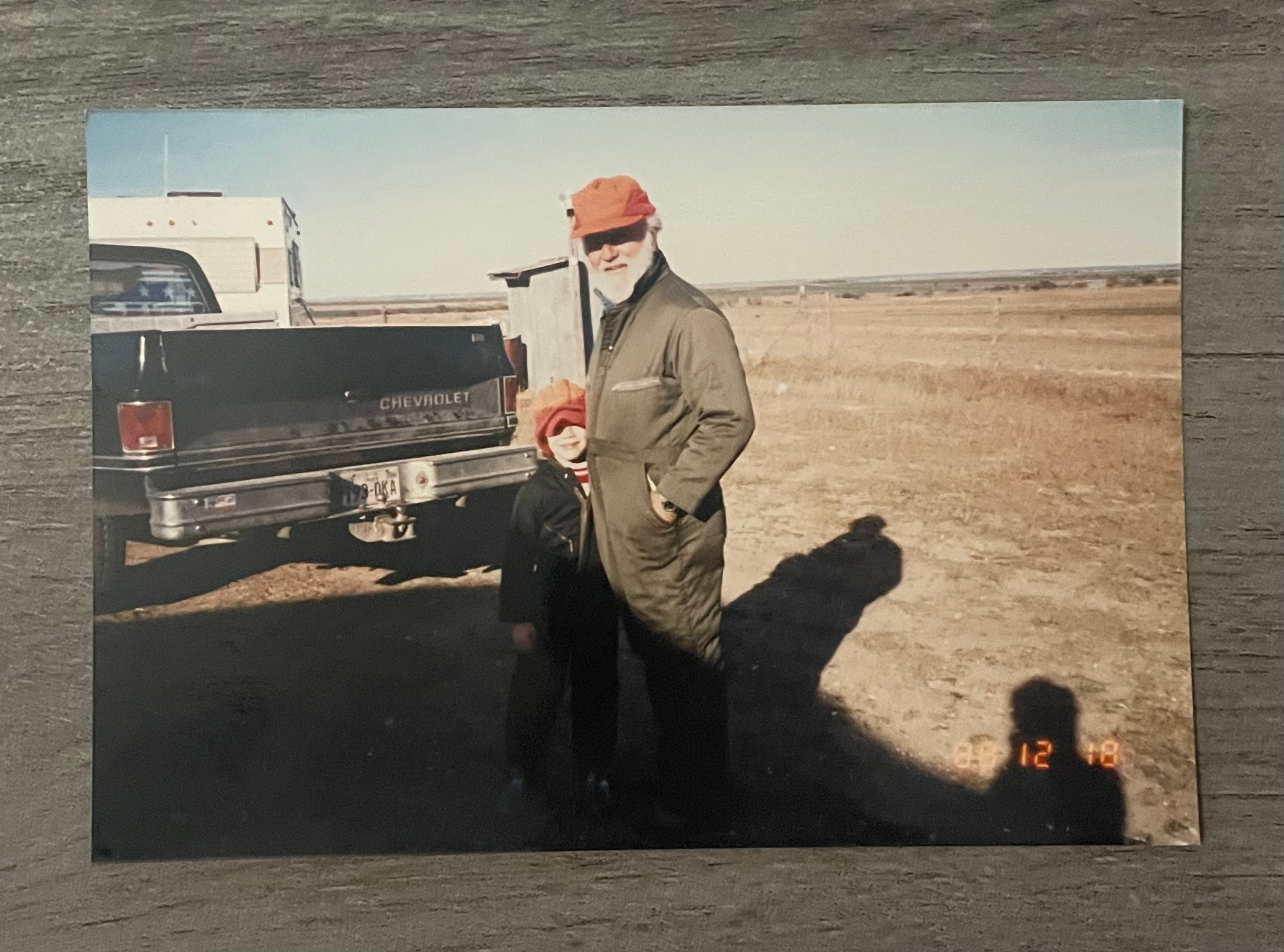
And so, we cut them out, put them in the cooler with our ham sandwiches and Dr. Pepper and slices of American cheese and grilled them for lunch the next day. Roadkill. Just barely, but roadkill all the same. —JAC
Love you, GrandDanny. —Aaron
Love you too, GrandMary. —Your Big Hunter.
Amazing storytelling, as usual, Aaron! Smiled and chuckled through the whole thing (minus the occasional heart twinge). Loved it!!
as an almost 25 year old who only ever killed one deer but loves bugs and spiders and critters of all kinds, I just gotta say this is the singular best thing I’ve read on this app, which I’m sad to say has taken too much of my time (which is precious and fleeting and terrifying), but at least it led me here eventually. This would make a darn good short film.